

Madrid has established itself as the leading destination for foreign investment in Spain. Its international connectivity, economic capacity, technology ecosystem and concentration of companies, institutions and talent make it a strategic platform for operating in Europe and developing international business.

Reasons to invest in Madrid
Madrid is not only Spain’s administrative capital. It is also one of its main economic, financial, business and institutional centres.
The concentration of international companies, funds, financial institutions, public administrations, universities and decision-making centres makes the region a particularly favourable environment for companies looking to enter the Spanish market, expand operations in Europe or establish an international base.
The data supports that position. In 2024, the Region of Madrid attracted €24.705 billion in foreign direct investment, equivalent to 67.1% of the total received by Spain. In 2025 it kept the lead with 51.9%, and during the first quarter of 2026 it once again accounted for approximately one in every two euros invested in the country from abroad.
Investing in Madrid does not only mean gaining access to the Spanish market. It means positioning yourself close to companies, institutions, capital, talent and connections capable of opening up opportunities in other markets.
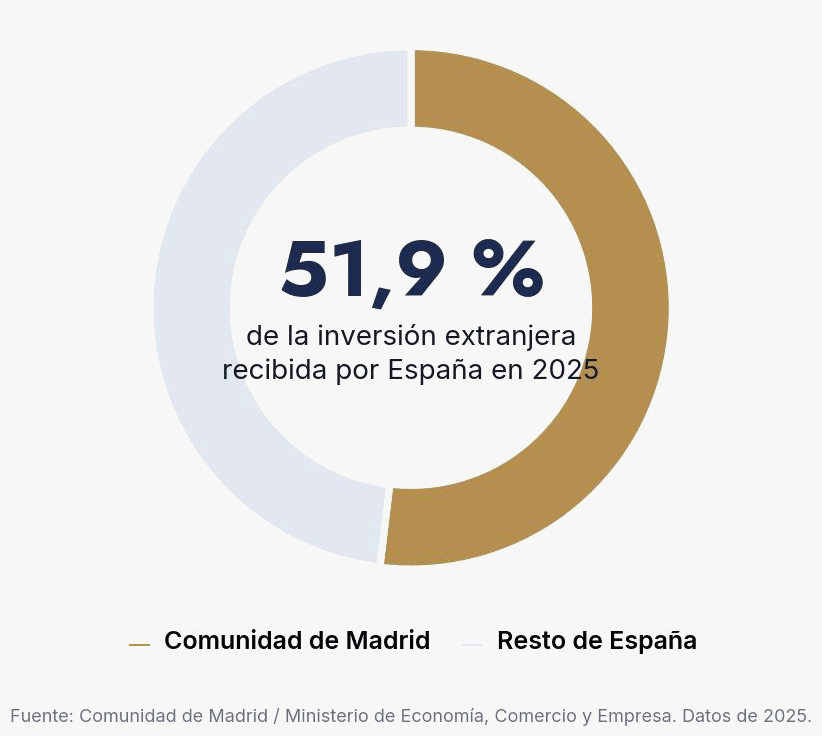
Madrid leads foreign investment in Spain
International investment can fluctuate significantly from one year to the next. A corporate acquisition, a capital increase or a large property transaction can alter the annual figures.
However, when Madrid’s performance is analysed over several years, its leadership does not appear to be the result of an isolated transaction. The region has consistently held a prominent position in attracting international capital.
In 2024 it received more than two out of every three euros of foreign direct investment arriving in Spain. In 2025, despite the drop in volume compared with the previous year, it remained well ahead of the other autonomous regions. Catalonia accounted for 14.7% and Aragon for 11%, against the 51.9% recorded by Madrid.
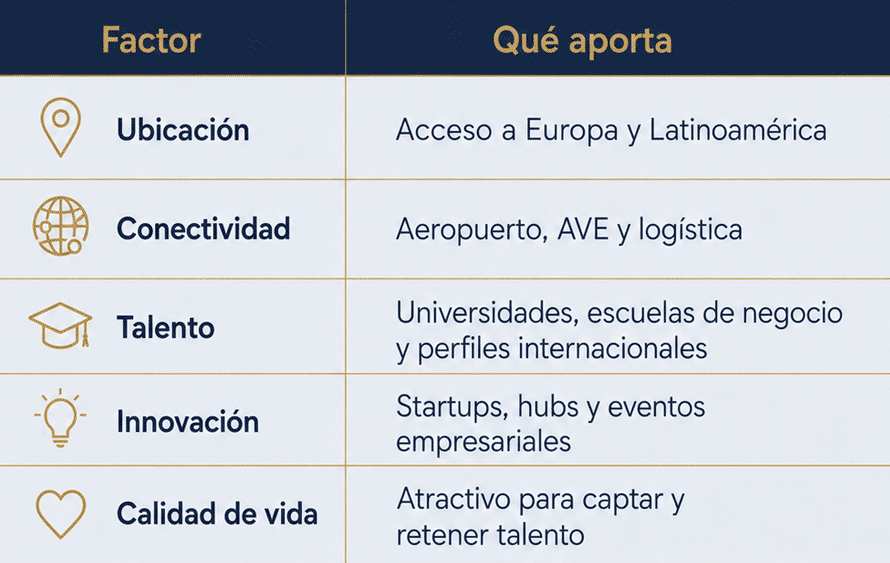
This ability to attract investment is linked to several factors:
- The presence of corporate headquarters and multinationals.
- Proximity to regulatory bodies and institutions.
- The availability of financial, legal and professional services.
- The concentration of executive and specialist talent.
- Connectivity with Europe, Latin America, the Middle East and Asia.
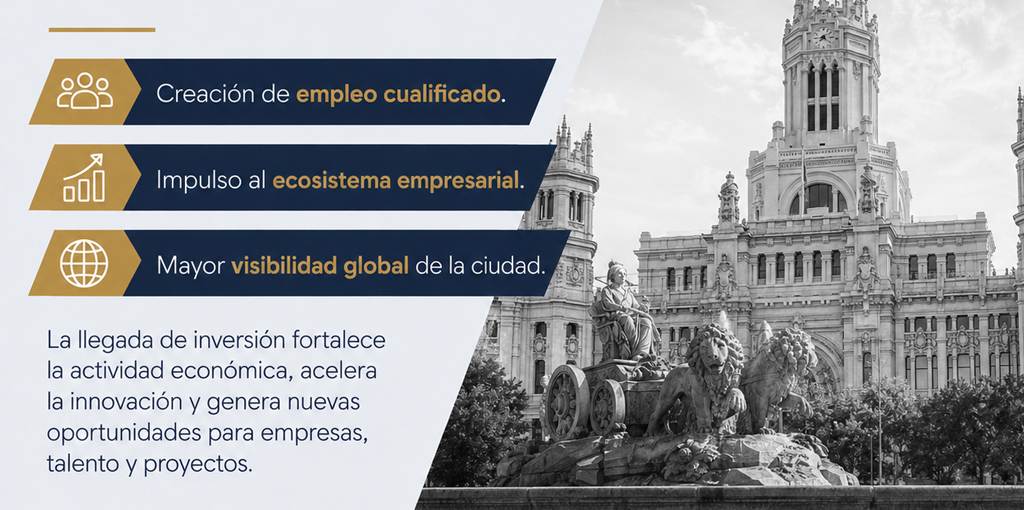
It is not only about receiving capital. Investment generates activity, skilled employment, suppliers, knowledge and new business relationships.
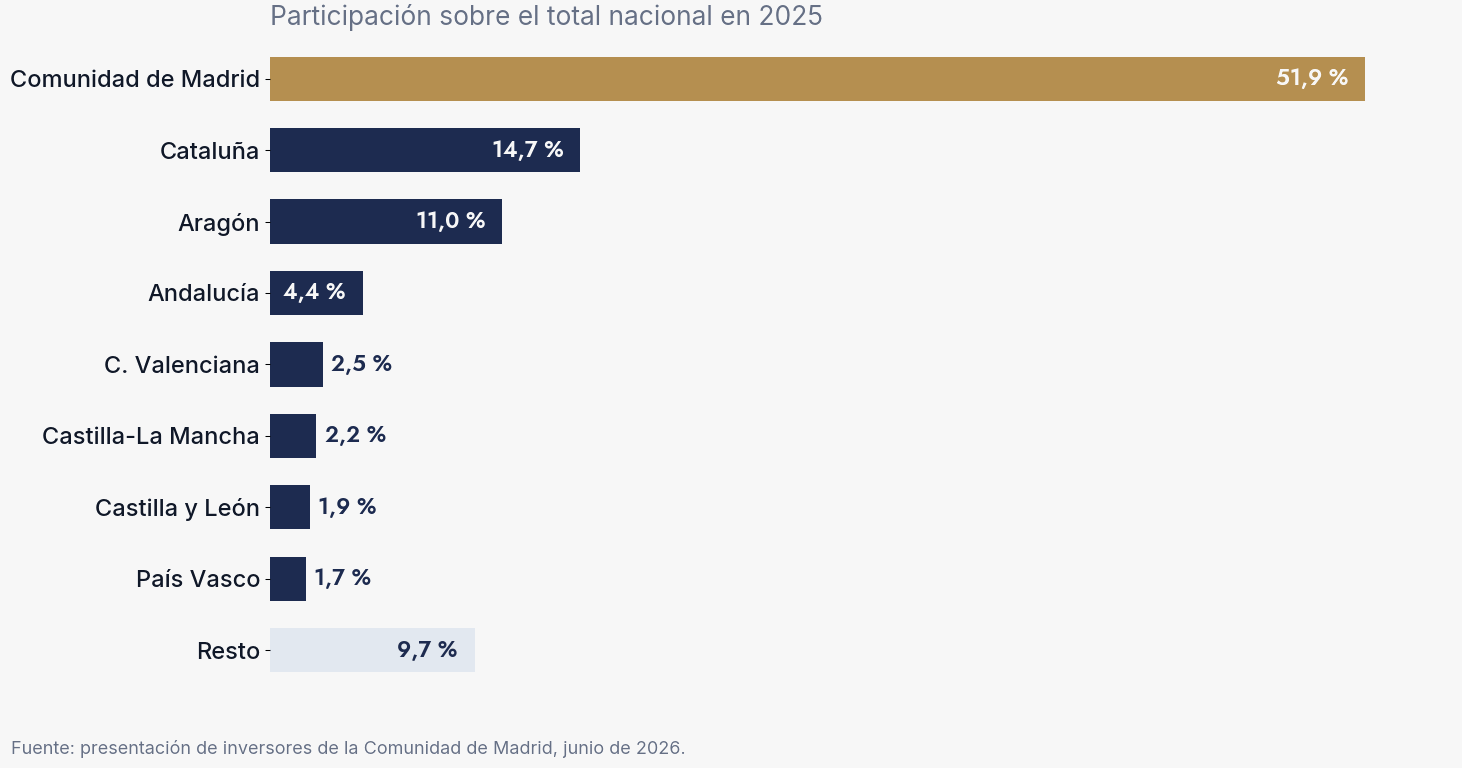
An economy with size and spending power
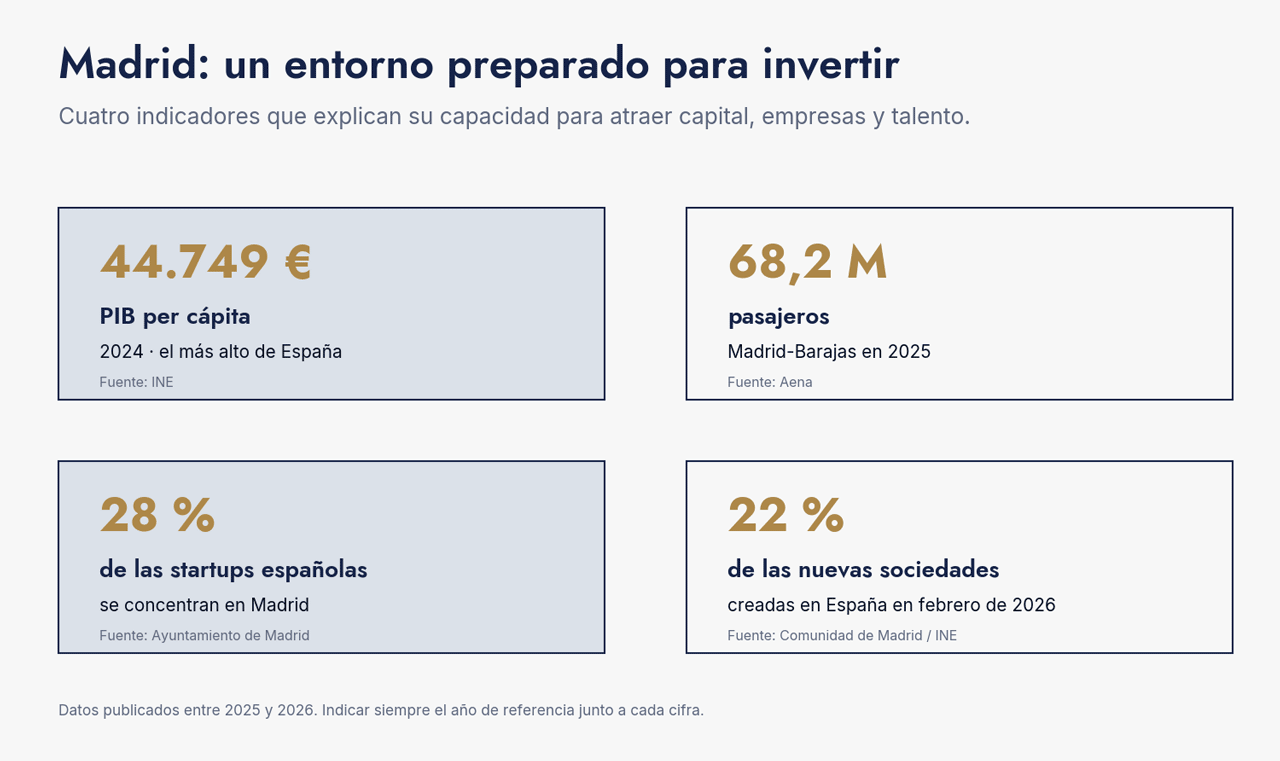
Madrid offers companies a market with considerable economic capacity. In 2024 it recorded a GDP per capita of €44,749, the highest of any Spanish autonomous region and roughly 37% above the national average.
This economic capacity matters for companies selling high value-added products or services, but also for those that need to be based close to:
- Large corporate clients.
- Public administrations and government bodies.
- Financial institutions.
- Funds and investors.
- Technology providers.
- Consultancies, law firms and professional services.
In addition, during the first quarter of 2026 the regional economy grew by 3% year on year, with investment among its most dynamic components.
Madrid therefore combines two advantages: a strong local market and a platform from which to operate across Spain as a whole.
International connectivity for doing business
An international investment also depends on how easy it is to move people, goods and equipment.
Adolfo Suárez Madrid-Barajas Airport closed 2025 with a record 68.2 million passengers, more than 430,000 movements and over 840,000 tonnes of cargo handled. It is Spain’s leading airport by passengers, freight and number of movements.
It currently connects Madrid with 228 destinations operated by 94 airlines. It also offers 156 intercontinental routes to 90 destinations in 40 countries.
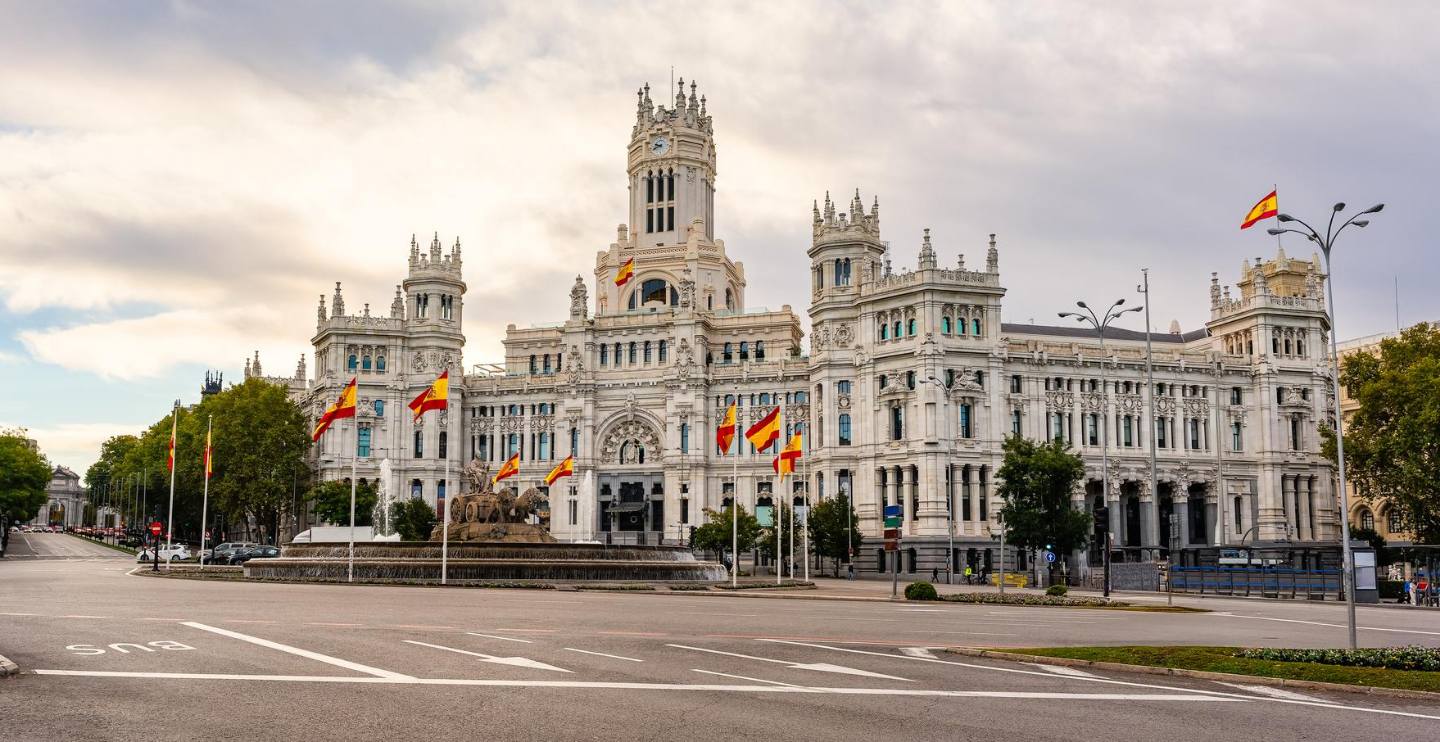
Spain’s capital, talent and international access
This connectivity makes the following easier:
Managing international teams. Executives, clients and partners can travel more easily.
Relations with Latin America. Madrid acts as one of the main business connection points between Europe and Latin American markets.
Access to the Middle East and Asia. The expansion of intercontinental routes strengthens its usefulness as a base for companies with global operations.
Hosting business events. Trade fairs, conferences, trade missions and international meetings find Madrid an accessible location.
In international business, a direct connection can save days of travel, stopovers and coordination. It is not a logistical detail. It can become a competitive advantage.
A growing technology and entrepreneurial ecosystem
Madrid has also become one of Spain’s leading technology hubs.
The city accounts for approximately 28% of Spanish startups and 34% of the investors in the national ecosystem. It also leads the country in the number of startups and technology companies.
The region represents around 30.7% of the Spanish digital market, while digitalisation already accounts for close to 24% of its regional GDP. Madrid also led Spanish investment in startups with €2.48 billion in 2023.
One of the most significant figures is the concentration of international investment in technology sectors. During 2024, Madrid received €8.3 billion in foreign investment in high-technology activities, equivalent to 85.3% of the national total allocated to these sectors.
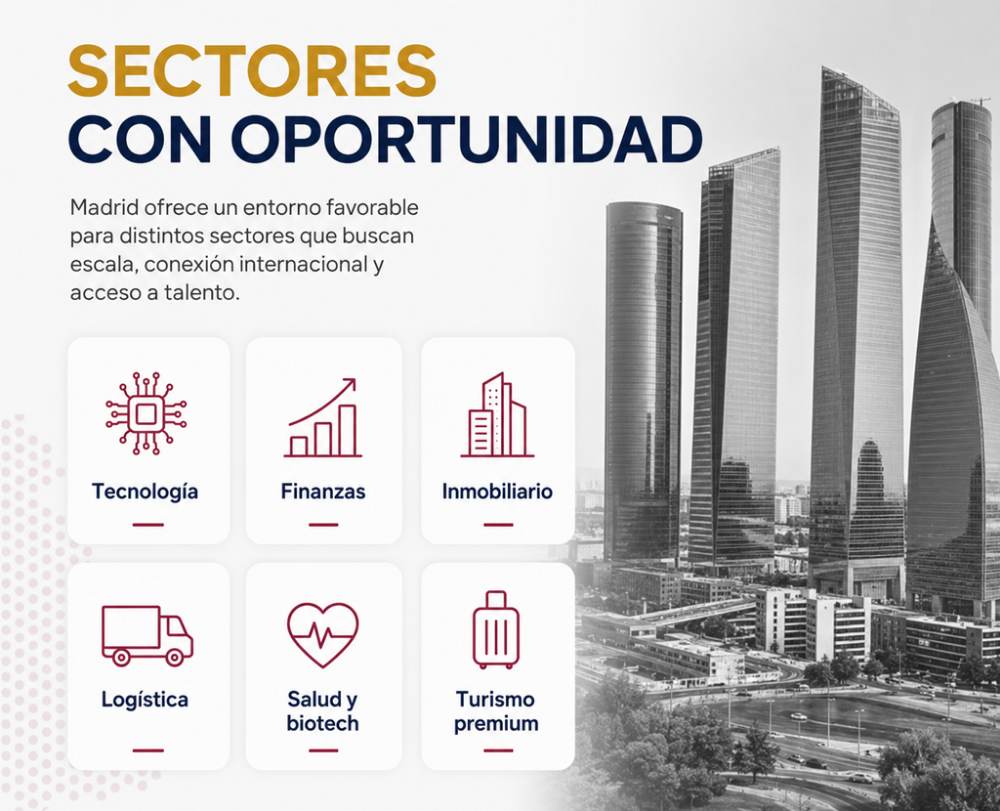
This environment is particularly interesting for companies working in:
- Artificial intelligence and software.
- Data and cybersecurity.
- Fintech and financial services.
- Aeronautics and aerospace.
- Biotechnology and pharmaceuticals.
- Video games and digital content.
- Energy and infrastructure.
- Specialist professional services.
For an international company, setting up in an ecosystem of this kind makes it easier to reach suppliers, professionals, technology partners and potential investors.
Company formation and business activity
The ability to attract investment goes hand in hand with a high level of entrepreneurial activity.
In February 2026, the Region of Madrid accounted for 22% of the new companies registered in Spain. In April of that same year, 2,537 companies were incorporated in the region.
The steady creation of companies generates an ecosystem of services around them: legal and financial advice, talent acquisition, marketing, technology development, logistics, professional premises and access to business networks.
For a foreign investor, this context makes it easier to find local suppliers, operating partners and teams able to support market entry.
Talent, universities and business education
Investment needs capital, but it also needs people prepared to turn it into activity.
Madrid has six public universities: Alcalá, Autónoma, Carlos III, Complutense, Politécnica and Rey Juan Carlos. There are also numerous private universities, international centres and business schools.
This concentration of education feeds a diverse labour market and encourages the connection between training, innovation and business.
Lecture halls sit alongside corporate headquarters, investment funds, public bodies, technology companies and international events. Learning is not confined to theory. It takes place within an active business ecosystem.
Source: EUDE Business School
Madrid as a platform for investment and international growth
Madrid brings together much of what an international investor looks for: capital, connectivity, market, talent, innovation, institutions and decision-making capacity.
Its leadership in foreign investment is not the only argument. The real advantage lies in how all these factors combine within a single territory.
For a company looking to grow in Spain or use the country as an international platform, Madrid can offer far more than a corporate address. It can offer access.
And in international markets, having access to the right people, institutions and opportunities is often as important as having a good product.
How ADISINI can help
ADISINI Consulting supports companies, organisations and investors through international expansion, market entry, institutional relations and alliance building.
The work begins before setting up: identifying the right counterparts, validating opportunities, preparing the proposal and building a presence capable of inspiring trust.
Because investing in Madrid is not only about arriving.
It is about knowing where to enter, who to talk to and how to turn an opportunity into a real business relationship.